Choosing between a 16-35mm and a 24-70mm isn’t about wide versus standard zoom in the way most people think. The real difference is narrower, and once you see it, the decision gets simpler and more personal.
Coming to you from Martin Castein, this thoughtful video reframes the debate around lenses like the Sony FE 16-35mm f/2.8 GM and the Sony FE 24-70mm f/2.8 GM II. Both lenses cover 24-35mm. That overlap is only 11mm on paper, but at the wide end, 11mm is not small. The visual jump from 24mm to 35mm is dramatic. Focal lengths do not feel linear. Each millimeter at the wide end changes perspective in a way you can’t ignore once you compare images side by side.
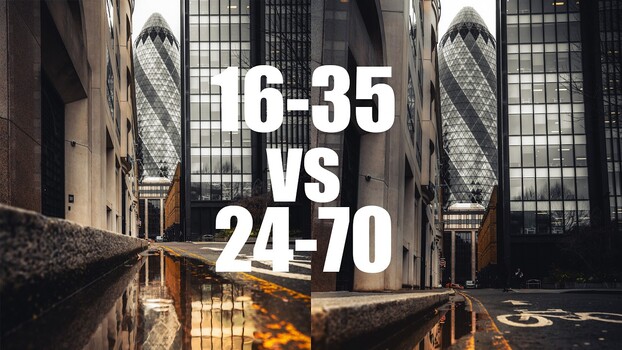
Castein walks through a clear example in London, using the Lloyd’s building. At 35mm and 24mm, you get solid images from across the street. Step back far enough and the building fits. But space runs out fast in city streets. You hit traffic. You hit walls. At 16mm, you move closer instead of farther. The position changes completely. You can stand near the base of the structure, tilt up, and create a bold, immersive frame that simply does not exist at 24mm. That shift is not about squeezing more into the frame. It is about accessing a composition that is otherwise impossible.
He shows the same idea with a low-angle reflection shot. At 16mm, you get close to a puddle and make it dominate the foreground while still capturing the building and surrounding lines. At 24mm, you must step back. The reflection shrinks. The relationship between foreground and background changes. The lens choice dictates how close you can work, and that distance shapes the entire feel of the shot.
Then the video pivots to the 35-70mm range, where the 24-70mm earns its keep. Castein focuses on portraits, many made at 70mm. Some dismiss 70mm as an awkward middle ground between 50mm and 85mm. He sees it differently. Think of 70mm as a wider 85mm. You get compression and subject isolation, but with a touch more environment when needed. In one comparison, a full-length frame at 40mm shows a model within her surroundings. Zoom to 70mm from roughly the same position and the frame tightens to head and shoulders. The background softens. The image shifts from environmental portrait to something more intimate without stepping forward or back.
That ability to hold your position and adjust framing with the zoom ring keeps perspective consistent. Lines stay natural. Faces do not warp. The scene feels stable while the composition changes. For portraits, family shoots, and travel images with people as the focus, that flexibility matters in a practical way.
Castein also points out that a 24-70mm covers more than many assume. Landscapes at 24-35mm sit comfortably within its range. Street scenes at 50mm are easy. You lose the ultra-wide look, but you gain reach up to 70mm. On the other hand, if people are rarely in your frame and you gravitate toward dramatic foregrounds, tight interiors, or dense city architecture, the 16-35mm often makes more sense as a primary lens.
The key tension comes down to this: do you need ultra-wide access, or do you need short-telephoto reach? Both lenses handle the middle. Only one gives you each extreme. Check out the video above for the full rundown from Castein.
#1635mm #2470mm #Focal #Range #Fits #Style #Fstoppers #trending #[now:year]