

I have come to find that the Nauticam WWL-1/C are my preferred big-animal optics. Despite the large size of many marine animals, fisheyes are still often too wide, whereas the slightly narrower field of view and the spectacular image quality from this optic are preferable. The WWL allowed me to fill a large portion of the frame with this manatee, light it easily, and capture some of the creature’s surroundings (Nikon Z5II, Nikon 24–50mm f/4–6.3, Nauticam WWL-C, dual Retra Maxi strobes, f/10, 1/125s, ISO 250)
Nauticam has become almost synonymous with “water-contact optics,” and of course with the high-end underwater housings that helped build the brand in the first place. Over the past decade, the company has pushed the boundaries of underwater optical design, but the turning point came more than 10 years ago with the release of their first dedicated water-contact wide-angle lens: the WWL‑1. At the time of its release, it was designed for compact camera systems and a few select Micro Four Thirds lenses.
Nauticam’s slogan “Innovation Underwater” is well-earned. Underwater photographers quickly discovered that it delivered something rare, at the time: truly exceptional image quality in a wet-mount system. Unlike traditional dome ports paired with rectilinear lenses, the WWL-1 used optics designed specifically to operate in water, correcting the optical issues that shooting underwater with land lenses traditionally suffer from.

While it isn’t as ideal for reef scenics as a fisheye lens is, the WWL is no slouch, and with careful compositions, it is still possible to create some nice reefscape images. The small size allows one to get up close and personal with the main subject while keeping subjects right on the lens, easy to light (Sony a1, Sony 28–60mm f/4–5.6, Isotta housing, dual Retra Pro Max strobes, f/13, 1/80s, ISO 100)
Because the WWL-1 is a wet lens, it can be attached or removed during a dive. Photographers no longer had to agonize over whether to shoot macro or wide on a given dive—you could do both. Start a dive shooting wide-angle scenes or big animals, and then remove the lens underwater to switch to macro work using the base lens and a diopter. Fast-forward more than a decade, and the WWL series has found renewed life with modern mirrorless and full-frame camera systems. Nauticam refined the concept with newer versions like the WWL‑1B (with a built-in float collar) and Nauticam WWL-C (designed for compacts) and related optics designed to pair with increasingly capable sensors and lenses.
The optical performance of the WWL design has remained remarkably competitive. Its sharpness, corner consistency, and color rendition continue to rank among the best available in underwater photography. While perhaps its optics don’t quite measure up to the iconic Nikonos RS 13mm, the fact that the WWL lenses have become my most-used underwater wide-angle optics might say it all. The combination of small size, great image quality, and wonderful versatility are hard to top, and I can’t imagine a day when I eschew the WWL from my gear bag.

The WWL is fantastic for sharks. Fisheyes are often a tad too wide for sharks, so the slightly narrower field of view of the WWL and the versatility to zoom a little if necessary can be invaluable. While this silky shark came quite close, shot with a fisheye, it wouldn’t have filled the frame nearly as nicely as it does on the 130-degree field of view of the WWL (Panasonic Lumix GH6, Olympus 14–42mm f/3.5–5.6 II, Nauticam housing, Nauticam WWL-1, dual Sea&Sea YS-250 strobes, f/13, 1/20s, ISO 100)
 |
 |
Same turtle, same lens! The above pair of images is a perfect example of the versatility of the WWL when paired with a zoom lens. On the wide end, the entirety of this massive loggerhead turtle is captured. On the zoomed in end, and focused right on the glass, I was able to get an intimate picture of the eye of this ancient mariner (Sony a1, Sony 28–60mm f/4–5.6, Isotta housing, dual Kraken KR-S160 strobes)
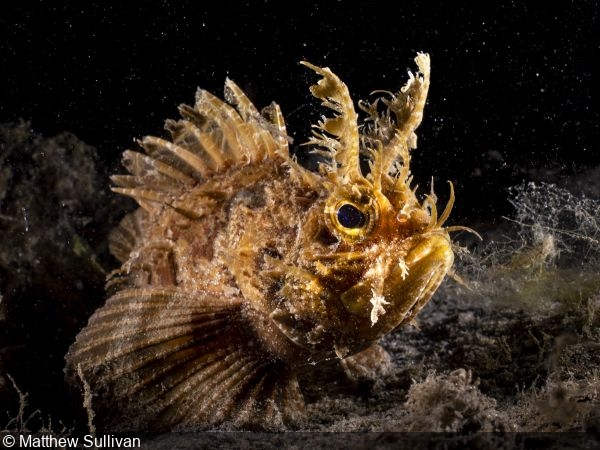
A well-endowed plumed scorpionfish: When used with zoom lenses, the WWL is able to focus right on the glass and becomes an impressive option for larger macro subjects, with stellar image quality (Panasonic Lumix GH6, Olympus 14–42mm f/3.5–5.6 II, Nauticam housing, Nauticam WWL-1, dual Sea&Sea YS-250 strobes, f/11, 1/320s, ISO 100)

I suspected the WWL-C might suffer a bit when shooting higher ISOs, natural light, and shallower depth of field, but I was pleasantly surprised at how well it held up. I suspected I’d lose quite a bit of image quality in the darkness with this southern stingray and without the details that lower ISOs and strobes bring out. While the edges of the frame aren’t overly sharp, the sharpness falls off naturally and inoffensively (Nikon Z5II, Nikon 24–50mm f/4–6.3, Nauticam WWL-C, f/8, 1/320, ISO 800)

The small size of the WWL make it fantastic for shallow water shooting like salmon rivers and creeks in Alaska, where a bigger dome or something similar would be problematic and limit compositions and lighting (Sony a1, Sony 28–60mm f/4–5.6, Isotta housing, dual Isotta RED64 strobes, f/13, 1/6s, ISO 100)

The world’s most iconic marine predator, the great white shark: While these fish are massive, they don’t always come close so the narrower field of view came in handy for this picture. Shot on a fisheye, the shark would’ve been miniscule in the frame and the image likely wouldn’t have worked (Sony a7R II, Sony 28mm f/2.0, Nauticam housing, Nauticam WWL-1, dual Retra Flash strobes, f/10, 1/200s, ISO 160)
| |||

#Favorite #Gear #Nauticam #WWL1C #trending #[now:year]