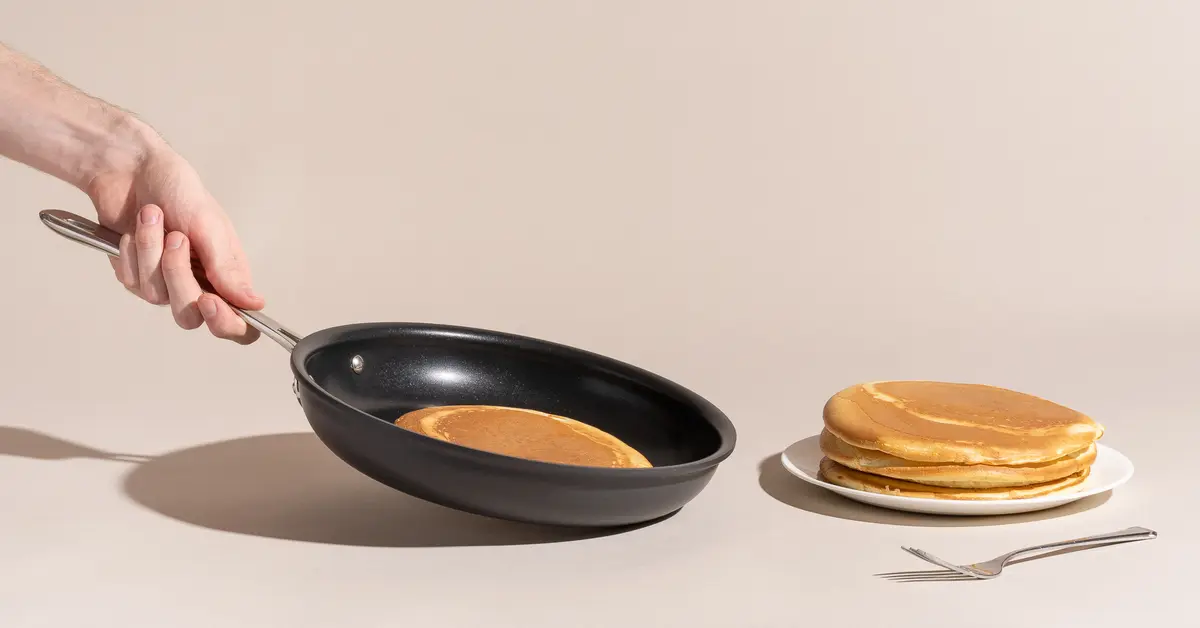
Non-stick ceramic pans are becoming an increasingly common alternative to non-stick PTFE pans, with brands touting them as “greener” and better-for-you options. These pans get their nonstick properties through a sol-gel (solution-gel) process in which they are coated with silica and other materials that typically do not contain PFAS.
After testing over a dozen ceramic skillets, frying dozens of eggs, flipping just as many pancakes, and frying delicate fish, we still don’t feel the need to recommend any of them. Here’s why:
Ceramic nonstick coatings are stickier than PTFE-based nonstick coatings. We’ve tested some of the most popular nonstick ceramic frying pans, and even the best ones perform worse than our favorite PTFE nonstick frying pan. Both egg whites and fish pieces stuck to the ceramic pans, while the Tramontina Professional always got clean results.
Pans can lose their non-stick properties after about a year, sometimes faster. Every time you heat a ceramic cookware, the coating releases a little silicone oil (on a molecular level), which prevents food from sticking. This means that the coating is self-destructive and the pan should release a certain amount of silicone oil no matter how carefully you handle it.
When we tested Caraway’s trendy ceramic nonstick frying pan, it lost its smoothness within a few months, and we’ve seen reviews of other pans that owners said lost their nonstick properties in just two months.
They tend to be more expensive than traditional nonstick frying pans. Our best nonstick PTFE frying pan costs about $35—a reasonable price for cookware that will likely need to be replaced in a few years. Meanwhile, the best-performing ceramic-coated frying pan we’ve tested costs nearly twice as much, and we’ve tried several ceramic frying pans costing more than $100.
It’s unclear whether they’re actually better for you and the environment. If cooking with ceramic-coated cookware was clearly safer and healthier than cooking with Teflon-coated cookware, the extra cost might be worth it. But little research has been published on the potential health problems associated with ceramic cookware, so there is no substantial evidence of its health benefits. Meanwhile, the use of metal oxides, silicone oil release, and faster deterioration of these coatings are a concern.
Regarding the environment: the production of PTFE coatings poses real risks to health and the environment. But since ceramic cookware has a much shorter lifespan than Teflon-coated cookware, these pans will end up in a landfill faster.
However, we understand that some home cooks are still drawn to ceramic cookware for one reason or another. If you decide to buy a ceramic nonstick frying pan, the improved OXO 10-inch frying pan showed the best results during testing. It releases food easily and we found the overall design to be balanced and the rounded handle to be comfortable to hold.
Best for…
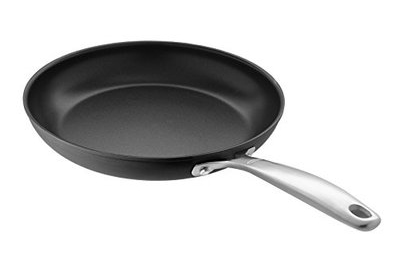
This ceramic-coated OXO pan skims food well and fits comfortably in your hand, but it’s not as good as a Teflon-coated pan.
This pan had the best nonstick properties of any ceramic pan we tested, delivering consistent food release with virtually no residue. The eggs we fried in this pan flipped and slid easily with less sticking than other ceramic models, and the tender fish fillets remained intact when removed from the pan.
We also liked the shape of the pan, with an 8-inch cooking surface and extended, shallower edges that make it easy to flip food with a spatula and slide it out. The pan is also well balanced—the handle fits comfortably in your hand, and the weight of the pan doesn’t strain your wrist.
The main drawback we noticed is that the pan is not completely flat; when we cracked the egg in the center, it slowly slid to the edge (and our hob is perfectly level). However, this was a fairly common problem among all the ceramic pans we tested, and most other pans were much less uniform.
Best for…
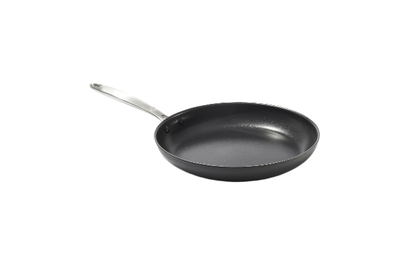
This ceramic frying pan is also from OXO and can be used on induction hobs.
OXO also makes an induction-friendly ceramic frying pan that impressed us the most: the OXO Ceramic Professional 10-Inch Nonstick Frying Pan. Although it’s pricey, we found it comfortable to use thanks to its wide, rounded handle and balanced design. It also performed on par with the OXO Enhanced frying pan, releasing food easily and cleanly, and heating more evenly than any other induction-compatible ceramic frying pan.
But again, we have concerns about the lifespan of these pans. We’ve seen an alarming number of reviews from owners of both models, with home cooks saying their pan was no longer nonstick after just a few months, or the coating was falling off in chips or flakes after rough cleaning or heavy use. (OXO offers a two-year warranty on the nonstick coating and a limited lifetime warranty on the cookware itself.)
Moreover, several customers claim that their warranty claims handled by OXO’s cookware partner, The Cookware Company, have been denied. According to an OXO spokesperson, “Minor rim chips, assembly damage, or gradual loss of non-stick properties are generally considered normal wear and tear and do not affect safety or functionality.”
#favorite #nonstick #frying #pan #trending #[now:year]