


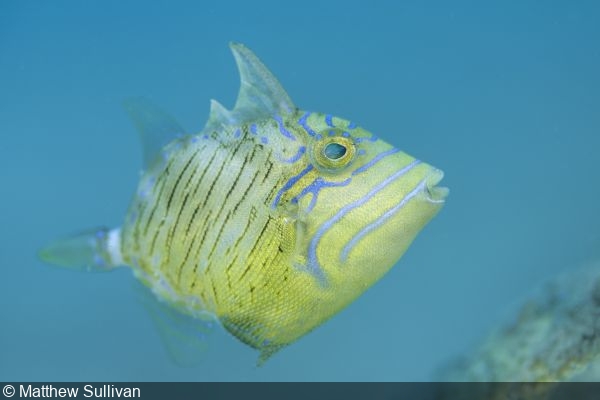

A stunning juvenile queen triggerfish. This species is exceedingly rare in Florida anywhere north of the Florida Keys and in 1000+ dives this is the first I’ve ever seen here. While this fish would look great and contrasty against a black background, the very shallow, bright water doesn’t allow for it. The blues of the background complement the yellows and blues on the fish, so I chose a wide (with regards to how close I was to the subject) aperture to help the fish stand out against a pleasing and not distracting background. (Nikon Z9, Nikon Z MC 105mm f/2.8 VR S, Nauticam housing, dual Retra Maxi strobes, Kraken Sports 7″ Monitor, 1/125s, f/7.1, ISO 64)
One of the general ‘rules’ with underwater macro photography, is to stop down your aperture. That is, to use a smaller aperture to maximize your depth of field, or how much of the image is in focus. And, this can be very good advice for a large percentage of small critters or underwater macro photographs. However, to help diversify your portfolio, to help separate a subject against an unappealing background, or simply to give a subject an aesthetic that more fits their vibe, using a wider aperture can be invaluable.
A wider aperture also allows for faster shutterspeeds, lower ISOs, and often a ‘dreamy’ look to your pictures. While I am a big fan of moody, contrasty images, in certain scenarios, that just isn’t called for and a softer touch is preferrable. This is a technique where I find good dive skills, and proper settings, paramount. Aspects like strobe positioning is a secondary or tertiary factor…something you won’t hear me say often! In my opinion, a pleasing shallow depth of field image can be quite difficult to achieve but the results can be well worth it and will add a whole new dimension to your underwater portfolio and a new skillset to your toolkit.

Blackspotted sunfish, a common freshwater fish in Florida, often hang in mucky areas that don’t make for great backgrounds. A narrow aperture not only blurred out the background pleasingly, but draws your attention directly to those big and adorable eyes. This is another benefit of using a wide aperture. Because less of your picture is in focus, you can draw a viewer’s attention to an exceedingly specific spot in the frame. (Sony a1, Sony 90mm f/2.8 Macro, Isotta housing, dual Kraken KR-S160 strobes, Kraken Sports 7″ Monitor, 1/250s, f/3.2, ISO 100)

For whatever reason, vertically-oriented subjects scream at my brain to shoot them as shallow depth of field images. This flamingo tongue was munching its way up a gorgonian. One of the challenges of this sort of picture is exactly which aperture is best. The difference between f/20 and f/22 is negligible. The difference between f/4 and f/3.2 at these magnifications is quite drastic. Experiment a bit, try a few different more open apertures to determine which gives you exactly the aesthetic you’re looking for. (Sony a1, Sigma 105mm f/2.8 DG DN Art Macro, Isotta housing, dual Retra Pro Max strobes, Kraken Sports 7″ Monitor, 1/160s, f/4.0, ISO 125)

One of my favorite times to use a wide aperture is when photographing a subject in busy surroundings. This seahorse was living in an area with patchy, clumpy, brown algae. The camouflage was exquisite but the seahorse blended in so well that creating a nice picture proved difficult, until I opened up the aperture, and drew attention to that beautiful eye, separating the animal from its displeasing surroundings. (Sony a9 III, Sony 90mm f/2.8 Macro, Nauticam housing, dual Retra Maxi strobes, 1/1250s, f/4.5, ISO 125)

At Atlantic longarm octopus warily eyes me from the entrance to its burrow. This species prefers rubble, sand, or seagrass substrates, none of which are especially attractive. Eliminating the background by using a black background is one option of course, but so is using a wide aperture. (Nikon Z9, Nikon Z MC 105mm f/2.8 VR S, Nauticam housing, dual Retra Maxi strobes, Kraken Sports 7″ Monitor, 1/160s, f/4.5, ISO 64)

Combining techniques here to make this beautiful painted frogfish stand out. Drawing focus to the angler using both a snoot and a wide aperture. Down deep, a slow shutterspeed and wide aperture were required to allow some natural light to bleed in, while keeping ISO low. Rather than using the snoot to create a blacked-out image, using a narrow aperture provides some context. (Sony a7R III, Sony 90mm f/2.8 Macro, Nauticam housing, single Retra strobe with Retra LSD, 1/15s, f/4.5, ISO 200)

At extreme magnifications, apertures that may not be especially wide, still give that sort of shallow depth of field effect. A pygmy seahorse, photographed with the Nauticam SMC, means razor thin focus. Pygmy images can often look a bit flat. A wide aperture gives some extra depth to the image and really draws the viewer’s focus right to the seahorse’s face. (Nikon D500, Nikon 105mm f2.8 VR Macro, Nauticam SMC-1, Nauticam housing, dual Retra strobes, 1/200, f7.1, ISO 100)

Another example of extreme magnification providing an assist with shallow depth of field. Normally, one would approach this bluebanded goby and shoot it with a narrow aperture to get much more of the fish in focus. While that can be a great choice, the perch this individual chose was ugly and detracted from the beauty of the fish. The shallow depth of field also makes the fish bleed into the background in a way I find pleasant. (Nikon D850, Nikon 105mm f2.8 VR Macro, Kraken Sports +13 Diopter, Nauticam housing, dual Retra strobes, 1/250s, f/6.3, ISO 64)
#Shallow #Depth #Field #Subject #Stand #trending #[now:year]


